Transforming myths into action
For many generations, local myths and cultural beliefs about bats have cultivated negative attitudes and perceptions and contributed to the destruction of their habitats. Josephine’s bat conservation initiatives aimed to counteract this pattern by promoting and implementing community – centered conservation approaches, engaging in interactive and hands – on learning experiences, outreach programs, educational campaigns, and sessions dedicated to busting myths (Bat science), alongside fostering environmental education and technological scientific innovations. The design integrated into a citizen science approach has helped to establish a strong component of community led conservation in two sites with important conservation needs.
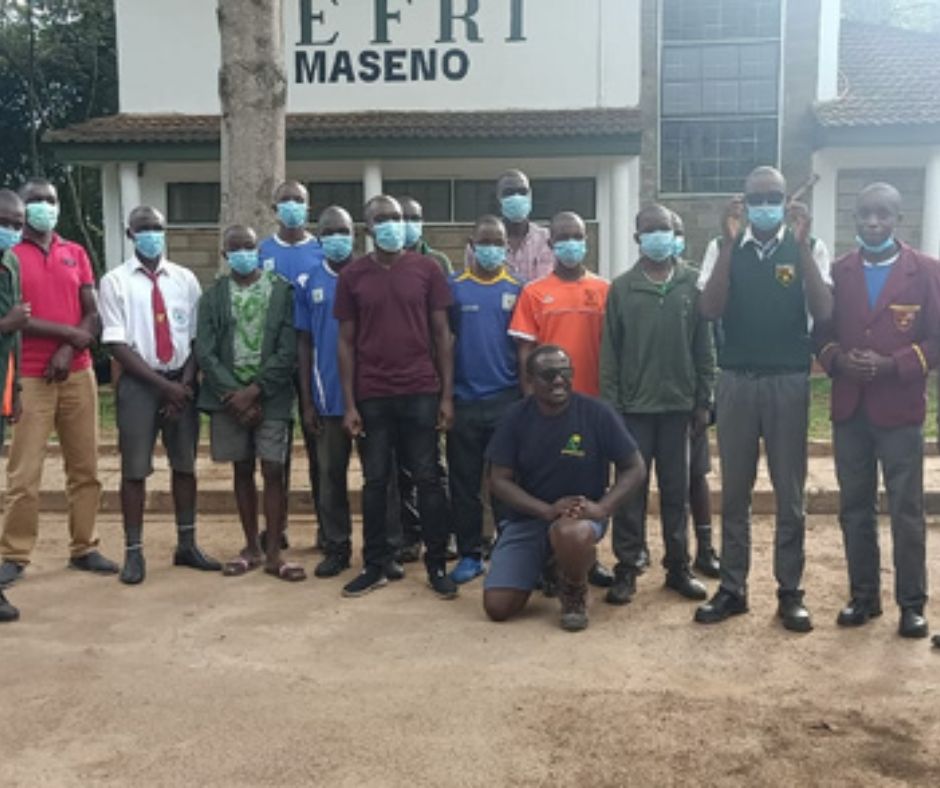
Josephine, Mr Evarastus, Maseno Boys students and their patron at Maseno Kefri.
Key achievements and implementations.
Through funding from the CLP and RSG along with collaboration with local stakeholders, the projects achieved significant milestones:
CLP team descending into Kaboga cave
. Economic and environmental impact
The conservation initiatives stimulated favorable responses from the local communities who acknowledged both economic and ecological importance of bats, leading to their active involvement in bat conservation efforts.
i) Establishment of school bat clubs: To ensure long-term sustainability, bat clubs were initiated in five local schools ( including Mbale High School, Maseno School, Gede School, Jimba School, and ACK Canon Mweri School) providing essential education about bat conservation to future generations
In the Coastal and Western parts of Kenya amid rising concerns about biodiversity loss, climate change, detrimental anthropogenic activities, pollution and misconceptions about bats, particularly negative perceptions tied to COVID -19, a quite crisis has been developing. Thanks to the dedication of Josephine, who has transitioned from a mentee to a member of staff (Project Coordinator and Gender Liaison Officer) at Angaza Vijiji, and through AV’s mentorship and Coaching program, along with her efforts, funding was secured from two prestigious international organizations, the Rufford Small Grants Foundation (RSG Grant – 2018) and the Conservation Leadership Programme (CLP – 2022). This support made it possible to launch essential innovative community – driven initiatives for bat conservation focused on protecting the Near Threatened Straw
Mr Evarastus, Simon, Proffesor Webala, Susan, and Hillary in Makuruhu cave
ii) Capacity building: Josephine and her project teams engaged 79 local citizen scientists (Kilifi) and 92 local citizen scientists (Vihiga and Kisumu Counties) improving their knowledge about bats and helping to demystify false myths regarding bats.
iii) Community monitoring scouts: The projects recruited and trained monitoring scouts from the surrounding areas including Mbale A, Mbale B, Ilwanda, Makuruhu, and Kaboga) to monitor bats and their habitats even in the absence of the project teams. These community led initiatives are still ongoing.
iv) Digital monitoring: With the help of Information Technology experts, Josephine’s RSG and CLP teams created digital platforms (including a mobile application and a back end platform for real time data collection, analysis and evaluation) to monitor bat dynamics and their habitats.
v) Community Led Conservation Action Plan (Vihiga County): Rather than a top- down approach, the RSG funded project incorporated local communities in drafting action plans aimed at Straw Colored Fruit bats conservation, thereby ensuring community stewardship in bat conservation efforts.
Colored Fruit Bats (Eidolon helvum) in Vihiga and Kisumu Counties, as well as the Endangered Hildegarde’s Tomb Bat (Taphozous hildegardeae) in Kilifi County which earned the respective RSG and CLP awards. The local communities
Empowering Community-Led Bat Conservation are now taking meaningful actions to change the situation. in Kenya. JosephineAmbaisi
https://www.google.com/url?sa=t&source=web&rct=j&opi=89978449&url=https://media.rufford.org/ media/ project_reports/33725-1_Final_Evaluation_Report.pdf&ved=2ahUKEwiQ3rCr_eqSAxXD4skDHcmz DLEQFnoECDIQAQ&usg=AOvVaw3jSpluQMcEUxb5gtej4cW8
Impact beyond conservation Josephine’s achievements are in line with Angaza Vijiji’s goal of promoting sustainable development in undeserved and marginalized rural areas in Kenya.
Josephine as once a mentee now a staff at Angaza Vijiji
Through Angaza Vijiji’s mentorship program, she honed her proposal writing skills, received RSG and CLP funding, and successfully linked scientific research and technological innovation to community involvement, making local communities become an integral part of bat conservation efforts.
The two projects illustrate how focused community based- conservation can safeguard bat species while simultaneously empowering local communities.
“The Conservation Leadership Programme and Rufford Small Grants have enabled me to contribute to Bat Conservation as bats are integral to pollination, pest control, seed dispersal among other benefits essential for local ecosystems and human well-being” Josephine.
“Angaza Vijiji has served as a beacon of hope, guiding and motivating me to become who I am today and will be in the realm of sustainable development. AV has been instrumental in my progression from an intern to a significant employment opportunity that has advanced my career, thank you Angaza Vijiji, for investing in my professional development” Josephine.
Looking ahead, Josephine aims to continue linking technology with community-led conservation to foster sustainable and inclusive conservation practices. Community-based conservation needs sustainable financial support, and she aims to write and submit more compelling proposals to secure funding for continued bat conservation efforts, believing in the motto,“bats are voiceless, we are their voice”